

Evaluation of early seeded multiple cuts winter cereals for livestock feed as a drought management strategy in Alberta
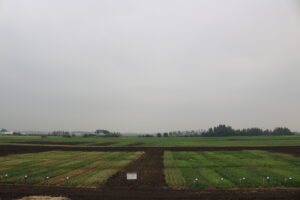
The Lakeland region of Alberta experienced one of the driest years since 2002, leaving many agricultural producers scrambling for feed and water resources for livestock and harvesting crops that were yielding as low as 30% of normal yields. As a result, many pastures were overgrazed in the fall of 2021 as producers searched for ways of extending available feed sources. Overgrazed pastures tend to produce less the following year and require additional management strategies that include reduced grazing days to ensure long-term recovery.
Winter cereals seeded in fall have been shown to provide an early season grazing opportunity for livestock producers. This could allow for delayed turnout into stressed perennial pastures, thus providing more recovery time for those forages. A second option is to seed winter cereals in the spring, which prevents the cereals from entering a reproductive stage, meaning that these winter cereals would remain vegetative through summer and fall. Current research into spring seeded winter cereals has focused on seeding during typical seeding times when temperatures are over 10°C.
Recent research conducted by Agriculture and Agri-Food Canada in Lethbridge has shown that as long as soil temperatures are between 2-6°C, spring wheat can be sown and produce commendable yields when compared to spring wheat sown when soil temperatures are over 10°C. This research was replicated by seven Applied Research Associations (ARA) across Alberta over a four-year period and found similar results.
Seeding early during drought conditions could allow these cereals to utilize early spring moisture from snow melt that might not be available later in the spring. However, this concept has not yet been evaluated for use in winter cereals for forage production.
Click here to view full report from our 2025 Annual Report
Click here to view full report from our 2024 Annual Report
