
Impact of allelopathic cover crops and its termination method in subsequently planted cash crops
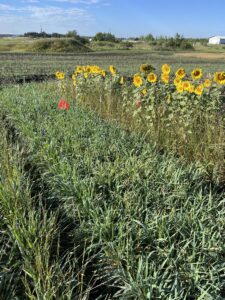
More than 60% of weed management is through recurring herbicide applications, leading increased instances of weed resistance. Allelopathy is the influence, usually detrimental, of one plant on another, where toxic substances are released when a plant dies, or produced through decaying tissue (Zimdahl R.L., 2018). These secondary metabolites may establish direct or indirect harmful or beneficial effects (Reigosa et al., 2006). Allelopathy can affect the growth and yield of another crop (Batish et al., 2001), b) develop autotoxicity, meaning chemicals expelled from plant residues of a species can hinder the growth of seedlings of the same species (Yu and Matsui, 1997). Thus, if managed properly, allelopathy can be a great alternative in weed management.
This study is preliminary and novel, because a) weed species and number of individuals per species will be evaluated within the allelopathic cover crop as well as the subsequent cash crops such as wheat, canola and peas and b) it aims to evaluate if allelopathy is affected if cover crops as well as cover crop mixtures are roller-crimped or incorporated in the soil before the cash crop is seeded. This research is unique because allelopathy is still an untouched subject for many growers. Extending knowledge through this project might increase grower interest in using allelopathic crops as another way to induce more weed suppression.
In the following growing season, cash crops such as canola, wheat and peas will be seeded as monocrop at each site respectively. Much like the first study year, soil samples will be collected for chemical analysis, a burndown herbicide application will be broadcasted before seeding and fertilization will be adjusted to target yields such as 40, and 50, for canola and wheat respectively (Government of Alberta 2024), as peas will not be fertilized. Harvest per plot will be weighed and recorded.
Click here to read full report from our 2025 Annual Report.
Click here to read full report from our 2024 Annual Report.
